
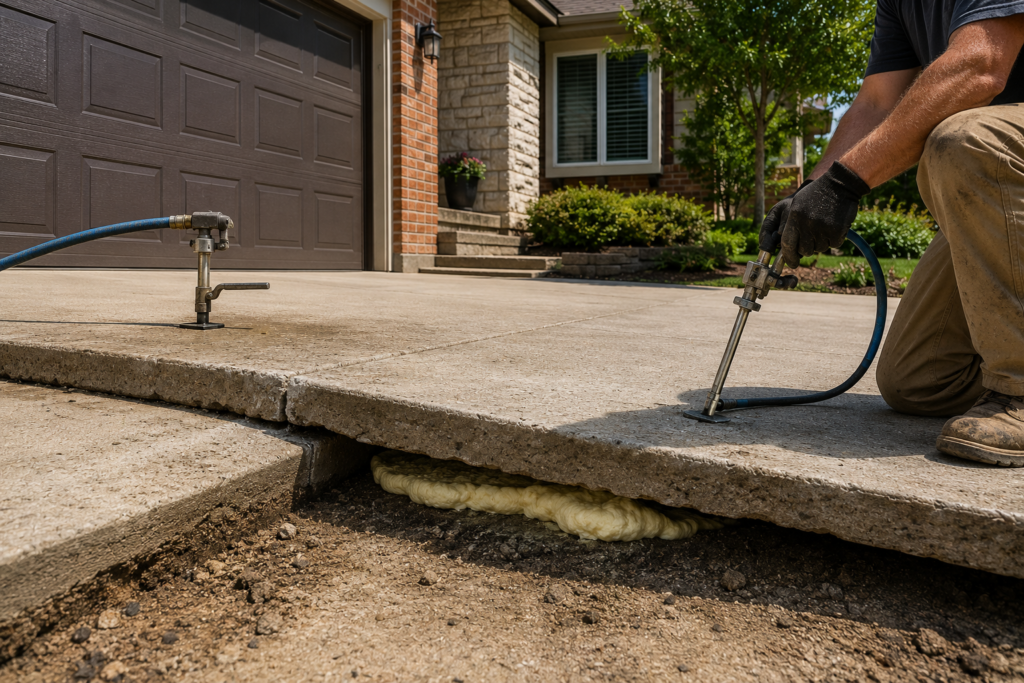
Uneven concrete driveways and garage floors are often caused by soil movement, erosion, and moisture changes beneath the slab. Early leveling solutions help restore stability, improve safety, and prevent more expensive concrete replacement later.
Key Takeaways
Concrete settlement often begins beneath the surface
Missouri soil conditions contribute to slab movement
Uneven concrete creates safety and drainage problems
Early leveling solutions help avoid full replacement
Moisture and soil erosion are major causes of sinking slabs
Concrete Doesn’t Usually Sink Overnight
Most homeowners first notice small signs:
Minor cracks
Slight sinking near garage doors
Uneven driveway edges
Water pooling after rain
At first, these issues may seem cosmetic.
But underneath the slab, the soil supporting the concrete may already be shifting or weakening.
Over time, the movement typically worsens and can eventually lead to:
Larger cracks
Drainage problems
Trip hazards
Structural instability
If your concrete is already showing signs of movement, learning more about driveway and garage leveling solutions can help prevent larger repair costs later.
Minor cracks
Slight sinking near garage doors
Uneven driveway edges
Water pooling after rain
Larger cracks
Drainage problems
Trip hazards
Structural instability
Why Missouri Soil Causes Concrete Movement
Missouri’s expansive clay soil naturally changes with moisture levels.
When soil becomes wet:
It expands
When it dries:
It contracts
This constant movement weakens the support beneath concrete slabs.
According to the U.S. Geological Survey, soil expansion and shrinkage are major contributors to slab settlement and structural movement throughout many regions of the United States.
This is one reason uneven concrete is so common across Missouri properties.
It expands
It contracts
Water Is Often the Hidden Cause
Many sinking driveways and garage floors are actually drainage problems in disguise.
Water can gradually:
Wash soil away beneath the slab
Create empty voids
Soften supporting soil layers
Once the support weakens, concrete begins settling unevenly.
According to the U.S. Environmental Protection Agency drainage resources, poor water management around residential properties significantly increases erosion and soil instability risks.
This is why standing water near driveways or garages should never be ignored.
Wash soil away beneath the slab
Create empty voids
Soften supporting soil layers
The Problem With Full Concrete Replacement
Many homeowners assume replacement is the only solution.
But tearing out and replacing concrete often means:
Higher costs
Longer project timelines
More disruption
In many cases, leveling existing slabs can restore stability without complete replacement.
This approach helps:
Lift sinking sections
Fill underground voids
Improve slab support
For many properties, this becomes a faster and more cost-effective solution.
Higher costs
Longer project timelines
More disruption
Lift sinking sections
Fill underground voids
Improve slab support
What Causes Voids Beneath Concrete?
Several issues may create empty spaces under slabs:
Several issues may create empty spaces under slabs:
Soil Erosion
Water slowly washes soil away.
Water slowly washes soil away.
Poor Compaction
Loose fill soil settles over time.
Loose fill soil settles over time.
Drainage Problems
Improper water flow weakens support layers.
Improper water flow weakens support layers.
Freeze-Thaw Cycles
Seasonal moisture changes create expansion and contraction.
According to the Federal Highway Administration, subsurface erosion and moisture intrusion are major causes of pavement and slab instability.
Seasonal moisture changes create expansion and contraction.
According to the Federal Highway Administration, subsurface erosion and moisture intrusion are major causes of pavement and slab instability.
Why Early Repairs Save Money
Concrete problems rarely stop on their own.
Small settlement issues often spread into:
Larger cracking
Additional sinking
Water drainage complications
Early leveling solutions usually cost significantly less than waiting until replacement becomes necessary.
Larger cracking
Additional sinking
Water drainage complications
How Modern Leveling Solutions Work
Modern leveling systems focus on restoring support beneath the slab.
This may involve:
Filling underground voids
Stabilizing weak soil
Lifting settled concrete
The goal is to restore proper alignment while improving long-term support conditions.
Compared to replacement, leveling often provides:
Faster completion
Less disruption
Lower overall cost
Filling underground voids
Stabilizing weak soil
Lifting settled concrete
Faster completion
Less disruption
Lower overall cost
Why Curb Appeal Matters Too
Uneven concrete affects more than function.
Sinking driveways and cracked garage floors can make properties appear:
Older
Poorly maintained
Unsafe
Restoring level surfaces improves:
Property appearance
Drainage performance
Overall usability
This is especially important for homeowners planning future resale value improvements.
Uneven concrete affects more than function.
Sinking driveways and cracked garage floors can make properties appear:
Older
Poorly maintained
Unsafe
Restoring level surfaces improves:
Property appearance
Drainage performance
Overall usability
This is especially important for homeowners planning future resale value improvements.
Signs Your Concrete May Need Leveling
Watch for:
Sinking slab sections
Uneven garage floors
Water pooling near concrete
Visible slab separation
Expanding cracks
These issues often indicate shifting support beneath the surface.
Addressing them early helps prevent larger structural complications later.
Sinking slab sections
Uneven garage floors
Water pooling near concrete
Visible slab separation
Expanding cracks
Frequently Asked Questions
Why do driveways sink in Missouri?
Expansive clay soil and water erosion are common causes of slab settlement.
Is leveling better than replacement?
In many cases, yes. Leveling is often faster and more affordable when the slab is still structurally intact.
Can water cause garage floors to sink?
Yes. Moisture can weaken soil support beneath concrete.