
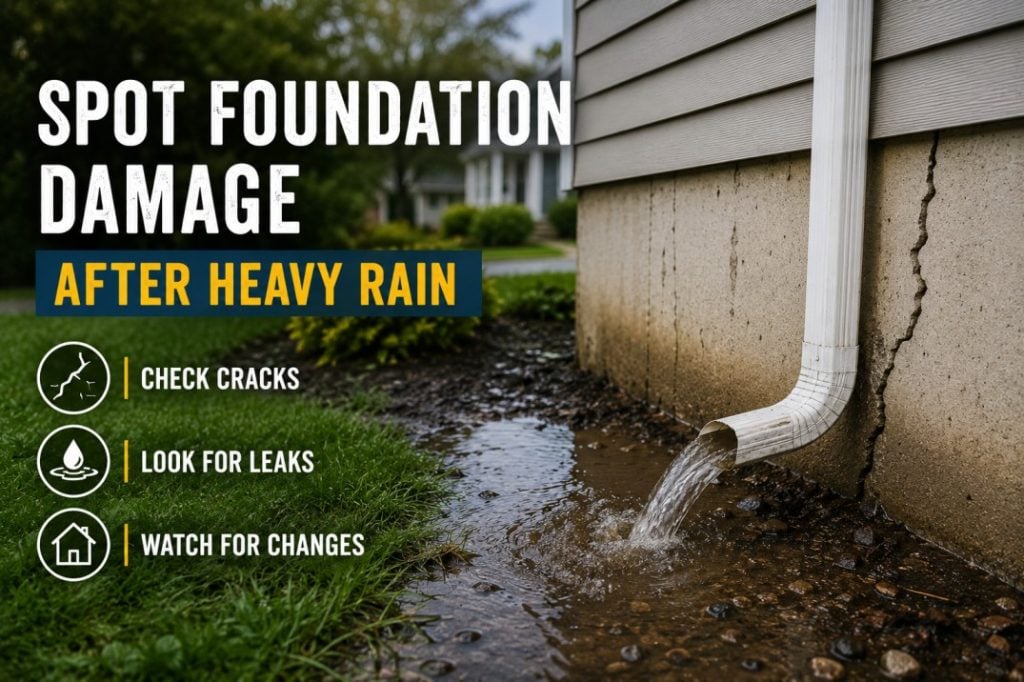
After heavy rain, check your home for new or widening foundation cracks, basement moisture, bowing walls, standing water, soil erosion, sticking doors, uneven floors, and crawl space moisture. Heavy rainfall can saturate soil around a home and reveal existing drainage or structural problems that may require professional attention.
The Rain Stopped. Your Foundation Inspection Should Start.
After several days of heavy Missouri rain, most homeowners naturally look for obvious storm damage.
They check the roof. They clear branches from the yard. They make sure the basement did not flood.
There is another part of the home worth checking.
The foundation.
Heavy rainfall can saturate the soil surrounding your home. When drainage is poor or structural problems are already developing, that additional moisture can expose issues that were much harder to notice during dry weather.
The good news is that you do not need to be a foundation expert to recognize many of the warning signs.
A careful 15-minute inspection after a major rain event can tell you a surprising amount about how your home is handling the water.
Here is where to start.
1. Walk the Property Before Going Inside
Your first inspection should happen outside.
Walk around the perimeter of your house shortly after the rain stops and look at where the water went.
Pay attention to:
Standing water beside the foundation
Mud collecting against foundation walls
Soil that has washed away
Overflowing gutters
Downspouts releasing water close to the house
Low spots directing runoff toward the foundation
Water should generally move away from your home.
If it repeatedly collects against the structure, improving dirt work and yard drainage may help address the source rather than continually dealing with the symptoms.
2. Look for New Foundation Cracks
Next, inspect any visible sections of the foundation.
Do not assume every crack means your home has a serious structural problem. Small cracks can develop for several reasons.
What deserves attention is change.
Look for:
A crack you do not remember seeing
An existing crack that appears wider
Horizontal cracking
Stair-step cracks
Cracks extending from windows or doors
Several cracks appearing in the same area
Take a photograph of anything suspicious.
Place a ruler beside the crack before taking the picture if possible. This gives you a useful reference if you need to determine whether it changes over the following weeks.
If cracks appear to be associated with structural movement, a professional foundation repair evaluation can help identify what is happening beneath the home.
3. Check the Basement While the Evidence Is Fresh
Do not wait until everything has dried.
The first 24 to 48 hours after heavy rainfall can be one of the best times to inspect a basement because moisture patterns are still visible.
Look along:
Basement walls
Floor edges
Corners
Windows
Utility penetrations
Foundation cracks
Watch for water stains, damp concrete, puddles, mineral deposits, or musty odors.
Pay particular attention to the joint where the basement wall meets the floor.
Recurring moisture after storms may indicate that water management around or beneath the foundation needs attention.
Missouri Foundation & Foam provides basement waterproofing solutions for problems including wall cracks, cove joint seepage, and other forms of basement water intrusion.
4. Look Beyond the Water
Finding water is important.
Finding out why it is there is even more important.
A homeowner may see a wet basement floor and assume the solution is simply sealing the nearest crack.
The actual cause could involve:
Exterior drainage
Groundwater
Foundation movement
A leaking window well
Hydrostatic pressure
Poor grading
An overwhelmed sump system
That distinction matters because treating only the visible symptom may allow the underlying problem to continue.
The U.S. Environmental Protection Agency’s moisture and mold guidance also emphasizes controlling moisture rather than allowing damp conditions to persist indoors.
5. Stand Back and Look at the Entire Basement Wall
Individual cracks can grab your attention so quickly that you forget to look at the wall itself.
Take several steps back.
Then look across the length of the basement wall.
Does it appear straight?
Does the center seem to push inward?
Are there horizontal cracks running across the wall?
Bowing or inward movement deserves professional evaluation, particularly when it appears alongside cracking.
Water-saturated soil can increase pressure against below-grade walls. Missouri Foundation & Foam provides bowed wall repair for homeowners experiencing this type of structural concern.
6. Test Your Doors and Windows
Now move upstairs.
Open and close several interior doors.
Try a few windows.
After significant foundation movement, homeowners sometimes notice:
Doors rubbing against frames
Doors no longer latching properly
Windows becoming difficult to open
Uneven gaps around frames
One sticking door does not automatically mean foundation trouble.
Humidity alone can cause wood to swell.
What matters is the pattern.
Several alignment problems appearing alongside new foundation cracks or uneven floors provide a stronger reason to investigate further.
7. Look for Changes in Floors and Interior Walls
Foundation movement can sometimes reveal itself far away from the foundation.
Walk through the house and pay attention to anything that feels or looks different.
Possible warning signs include:
Sloping floors
New drywall cracks
Cracks above doors or windows
Gaps between walls and ceilings
Trim separating from walls
Flooring pulling away from baseboards
Again, you are not looking for perfection.
Older homes naturally develop small imperfections.
You are looking for recent changes, particularly changes that appeared around the same time as heavy rainfall or basement moisture.
8. Inspect the Crawl Space
If your home has a crawl space, it deserves the same attention as a basement.
Heavy rain may leave moisture beneath the house even when the living areas remain completely dry.
Look for:
Standing water
Damp soil
Wet insulation
Condensation
Musty odors
Sagging insulation
Visible moisture on structural materials
Persistent crawl space moisture should not become a normal part of rainy weather.
Professional crawl space repair and waterproofing can help address moisture conditions beneath Central Missouri homes.
9. Check the Sump Pump
Heavy rain is when your sump pump earns its keep.
If you have one, inspect it after significant rainfall.
Listen for unusual sounds and confirm that collected water is being discharged properly.
Warning signs include:
Pump running continuously
Pump not activating
Water rising unusually high in the basin
Discharge water returning toward the foundation
Unusual grinding or rattling sounds
A sump pump failure can quickly turn a manageable groundwater issue into a wet basement.
If your current system is unreliable or your home does not have adequate protection, professional sump pump installation may provide another layer of water management.
10. Look at Your Gutters From the Ground
You do not necessarily need to climb onto the roof.
Look at what happened beneath the gutters.
Deep marks in landscaping, washed-out mulch, or unusually wet soil can indicate that water overflowed from above.
Also check where each downspout terminates.
If thousands of gallons of roof runoff repeatedly end up beside the foundation over multiple storms, the surrounding soil can remain much wetter than necessary.
The EPA’s stormwater management resources provide additional information about managing rainwater and reducing runoff around properties.
A Useful Trick: Photograph the Same Places After Every Major Storm
Memory is unreliable.
Photographs are not.
Create a folder on your phone called Foundation Check.
After significant storms, photograph the same locations:
Existing foundation cracks
Basement corners
Exterior foundation walls
Problem drainage areas
Crawl space conditions
Downspout discharge locations
Date the photographs.
If a crack gradually widens over six months, you will have a much clearer record of the change.
That information can also be helpful when discussing the problem with a foundation professional.
When Should You Be Concerned?
Not every damp spot or small crack requires major foundation work.
Some conditions, however, deserve quicker attention.
Consider scheduling a professional inspection when you notice:
New horizontal cracks
Rapidly widening cracks
Bowing basement walls
Significant stair-step cracking
Repeated basement water intrusion
Noticeably uneven floors
Several doors suddenly becoming difficult to close
Standing water that repeatedly collects beside the foundation
Multiple warning signs occurring together
The objective of an inspection should be to identify the cause before deciding on a repair.
That is especially important because structural movement, drainage problems, and waterproofing concerns can sometimes produce similar symptoms.
What Not to Do After Heavy Rain
Homeowners naturally want to fix visible problems quickly.
That instinct can sometimes hide valuable evidence.
Avoid immediately painting over water stains or filling every crack before determining why it appeared.
A sealed crack may look better while the foundation continues moving.
Likewise, waterproof paint may temporarily hide moisture without addressing the water reaching the wall.
Start with diagnosis.
Then choose the solution.
A Simple Post-Rain Foundation Checklist
After a significant Missouri storm, spend a few minutes checking:
Outside
✓ Standing water near the home
✓ Soil erosion
✓ Downspout discharge
✓ Exterior cracks
✓ Poor grading
Basement or Crawl Space
✓ Damp walls
✓ Water along floor edges
✓ New cracks
✓ Bowing walls
✓ Standing water
✓ Sump pump operation
Inside the Home
✓ Sticking doors
✓ Difficult windows
✓ New drywall cracks
✓ Uneven floors
✓ Gaps around trim
You do not need to find every possible symptom.
Even one noticeable change is worth documenting and monitoring.
Frequently Asked Questions
Can heavy rain damage a foundation?
Heavy rainfall can saturate the soil surrounding a foundation and contribute to conditions that place additional pressure on foundation walls or expose drainage and settlement problems. Rain may also make existing foundation issues more noticeable.
Why do foundation cracks appear after heavy rain?
Changes in soil moisture can affect the soil surrounding and supporting a foundation. A crack appearing after rainfall may indicate movement, but the crack should be evaluated in context with its size, direction, location, and other symptoms.
Is water in my basement after heavy rain normal?
Recurring basement water should not simply be considered normal. It may indicate drainage, waterproofing, foundation, window well, or groundwater problems that should be investigated.
How soon after heavy rain should I inspect my foundation?
The first inspection should ideally happen within 24 to 48 hours, while moisture patterns are still visible. Continue monitoring cracks and other suspicious areas over the following weeks.
Who should I call if I find foundation damage after rain?
If you notice structural cracks, bowing walls, recurring water intrusion, or other signs of foundation movement, contact an experienced foundation repair and waterproofing professional for an evaluation.
Heavy Rain Can Reveal What Dry Weather Hides
A major storm is not only something your home needs to survive.
It can also act like a stress test.
Heavy rainfall shows you where water collects, where drainage struggles, where moisture enters, and where structural problems may already be developing.
Pay attention to those clues.
A new crack photographed today is easier to monitor.
A drainage problem discovered now is easier to correct.
A damp basement investigated early is easier to manage than one that floods during the next major storm.
Missouri Foundation & Foam works with homeowners throughout Auxvasse, Columbia, Jefferson City, and Central Missouri on foundation repair, basement waterproofing, crawl space repair, drainage, and other solutions designed to help keep homes dry and stable.
If the latest storm left you wondering whether something has changed beneath your home, visit Missouri Foundation & Foam to learn more or schedule an inspection.