
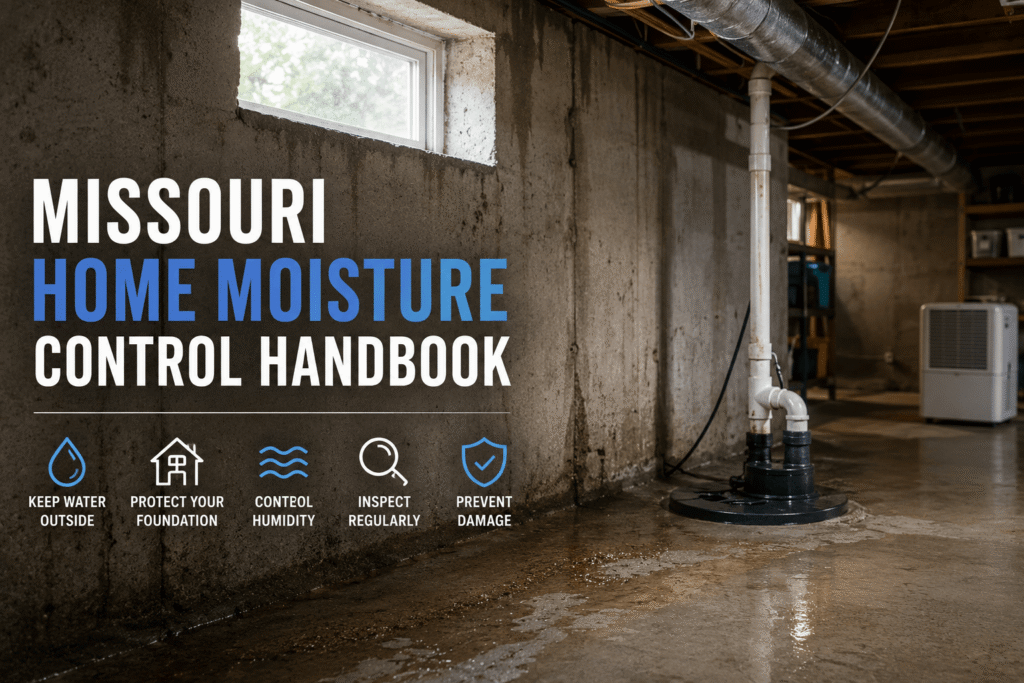
Missouri homeowners can control excess moisture by managing roof runoff, maintaining proper grading, controlling basement and crawl space water, using sump pumps where appropriate, repairing water-entry points, and maintaining reasonable indoor humidity. The best solution depends on where the moisture originates, so identifying the source should come before choosing a repair.
Missouri Home Moisture Control Handbook
You walk downstairs after a long stretch of rain and notice that familiar basement smell.
Nothing is flooded.
There is no dramatic stream of water running down the wall.
But something feels damp.
That is exactly how many home moisture problems begin.
Water problems are not always obvious emergencies. Sometimes they appear as condensation on a pipe, a damp basement corner, musty crawl space air, or a white powdery residue on concrete.
For Missouri homeowners, changing weather and periods of heavy rainfall make moisture management an important part of routine home maintenance.
This handbook will help you figure out where moisture may be coming from, what you can check yourself, and when the problem deserves professional attention.
First, Find the Water Before Trying to Stop It
One of the easiest mistakes is starting with a product instead of a diagnosis.
Homeowner sees damp wall.
Homeowner buys waterproof paint.
Problem solved?
Maybe not.
Water could be coming from several places:
Rainwater collecting beside the foundation
Groundwater
Plumbing leaks
Indoor humidity
Condensation
Foundation cracks
Window wells
Crawl space soil
Poor exterior grading
Different moisture sources require different solutions.
Before spending money, ask:
Where is the moisture actually coming from?
That single question can save a lot of unnecessary work.
1. Start at the Roof
Moisture control begins much higher than the basement.
Your roof collects a tremendous amount of water during a storm.
That water needs somewhere to go.
Check your gutters for:
Leaves
Debris
Overflow
Sagging sections
Loose connections
Then follow the downspouts.
Where does the water end up?
If it empties immediately beside the foundation, you may simply be moving water from the roof to the exact place you do not want it.
The goal is to direct roof runoff safely away from the structure.
2. Walk Around Your House During or After Rain
Dry weather can hide drainage problems.
Rain reveals them.
After a Missouri storm, walk around the property and look for:
Standing water
Mud beside the foundation
Washed-out landscaping
Downspout problems
Water flowing toward the house
Low areas beside foundation walls
Pay particular attention to spots that remain wet after other areas have dried.
The EPA’s stormwater resources provide additional guidance on managing rainfall and reducing problematic runoff around properties.
If your property consistently directs water toward the house, professional dirt work and drainage improvements may help correct the problem at its source.
3. Check the Slope Around Your Foundation
Your yard does not need to look dramatically uneven for grading to cause trouble.
Even subtle low areas can influence where rainwater collects.
Stand several feet away from the house and look toward the foundation.
Does the ground appear to encourage water away from the structure?
Or does it create a shallow bowl beside it?
Soil can settle over time, especially around areas that were previously excavated.
That means grading should occasionally be reassessed rather than assumed to remain correct forever.
4. Learn What Your Basement Is Telling You
A basement can provide useful clues about what is happening outside and beneath the home.
Look for:
Damp walls
Wet floor edges
Puddles
Water stains
Peeling finishes
Musty odors
Mineral deposits
Moisture around cracks
Do not just look in the middle of the wall.
Inspect corners, windows, utility penetrations, cracks, and the area where the wall meets the floor.
If moisture repeatedly appears after rain, professional basement waterproofing can help determine how water is entering and which solution fits the problem.
5. Do Not Ignore White Powder on Basement Walls
Sometimes water leaves evidence even after it disappears.
A white, chalky material on masonry or concrete can be efflorescence, which occurs when moisture moves through mineral-containing materials and leaves salts behind as the water evaporates.
Efflorescence itself is not necessarily structural damage.
But it can be a useful clue that moisture has been moving through the material.
Instead of simply cleaning it off every few months, investigate why the wall is repeatedly becoming damp.
6. Inspect Foundation Cracks
Not every foundation crack is an emergency.
But cracks can provide pathways for water.
After heavy rainfall, check existing cracks for:
Dampness
Active seepage
Mineral staining
Changes in width
New cracking nearby
A crack that remains dry and unchanged deserves different attention than one that leaks during every storm.
For appropriate cracks, professional crack injection may be one part of the solution.
However, sealing a crack should not replace investigating structural movement or broader drainage problems when those conditions are present.
7. Do Not Forget the Crawl Space
Crawl spaces are easy to ignore because homeowners rarely enter them.
Moisture does not care whether you visit.
From a safe access point, check for:
Damp soil
Standing water
Condensation
Wet insulation
Musty odors
Darkened wood
Visible moisture
Bare soil can also release moisture into the crawl space environment.
Depending on the home’s conditions, crawl space repair and moisture-control measures such as a vapor barrier may be appropriate.
The solution should still begin with identifying active water sources.
8. Know the Difference Between a Water Leak and Humidity
Not every damp basement has water pouring through a wall.
Sometimes the problem is humid air meeting a cooler surface.
You may notice condensation on:
Pipes
Ductwork
Windows
Foundation surfaces
Other cool materials
A simple humidity meter can help you monitor indoor conditions.
A dehumidifier may help manage indoor humidity.
However, it should not be expected to solve active groundwater intrusion.
Those are two different problems.
9. Test Your Sump Pump Before You Need It
A sump pump is easy to appreciate after the basement starts filling with water.
That is a little late to discover it does not work.
Periodically inspect your system.
Check:
Whether the pump activates properly
Whether the basin contains excessive debris
Where discharge water goes
Whether the discharge line is obstructed
Whether water flows back toward the foundation
Homes with recurring groundwater issues may benefit from professional sump pump installation as part of a broader water-management system.
10. Watch Your Basement After Heavy Rain
Timing matters.
If you inspect the basement three weeks after a storm, much of the useful evidence may already be gone.
Instead, check within the first day or two.
Take photographs of:
Damp areas
Water trails
Leaking cracks
Wet corners
Sump activity
Then compare those areas after the basement dries.
You may begin recognizing patterns.
Perhaps one wall becomes damp only during wind-driven rain.
Maybe water always appears where the wall meets the floor.
Patterns make diagnosis much easier.
11. Pay Attention to Musty Odors
Your nose can sometimes detect moisture trouble before your eyes do.
A persistent musty smell can indicate damp conditions even when visible water is absent.
Do not simply mask the odor.
Investigate:
Basement carpeting
Stored cardboard
Crawl spaces
Behind finished walls
Insulation
Areas around plumbing
The EPA’s mold and moisture guidance emphasizes controlling moisture as a key part of addressing mold-related conditions.
In other words, cleaning the visible symptom without controlling the water source can allow the problem to return.
12. Be Careful With Basement Storage
A basement can become the unofficial storage department of the entire house.
Holiday decorations.
Old photographs.
Important paperwork.
Clothing.
Furniture.
If your basement has a history of moisture, avoid placing vulnerable belongings directly on the floor or tightly against foundation walls.
Use moisture-resistant storage containers when appropriate and leave enough space to inspect problem areas.
You cannot notice a damp wall if 30 boxes are hiding it.
13. Check Around Basement Windows
Window wells can become overlooked collection points.
Inspect them after storms.
Look for:
Standing water
Debris
Poor drainage
Damaged covers
Gaps
Water staining
If water repeatedly collects against a basement window, address the drainage problem rather than waiting for it to find a path inside.
14. Know When Moisture May Be Connected to Foundation Movement
Sometimes water and structural problems overlap.
Watch for moisture accompanied by:
Horizontal cracking
Bowing walls
Stair-step cracks
Widening foundation cracks
Uneven floors
Doors suddenly sticking
Visible wall movement
At that point, the issue may involve more than waterproofing.
A professional foundation repair evaluation can help determine whether structural movement is contributing to the moisture problem.
What Should You Check Each Season?
Missouri homes experience different moisture challenges throughout the year.
Spring
Focus on:
Heavy rainfall
Gutters
Downspouts
Basement seepage
Sump pump operation
Yard drainage
Summer
Watch:
Indoor humidity
Crawl space moisture
Condensation
Musty odors
Fall
Prepare by:
Cleaning gutters
Removing leaves from drainage areas
Inspecting foundation cracks
Checking grading
Winter
Look for:
Plumbing leaks
Snow or ice drainage issues
Basement condensation
Changes in existing foundation cracks
The goal is not to obsess over your foundation.
It is simply to notice changes early.
The Moisture-Control Mistakes Worth Avoiding
Painting Over a Wet Wall
Waterproof coatings may have appropriate applications, but paint alone does not automatically correct the reason water is reaching the wall.
Running a Dehumidifier Against Active Water Intrusion
A dehumidifier manages humidity. It does not redirect groundwater.
Sealing Every Crack Without Investigating It
Understand whether the crack is simply allowing water through or is associated with structural movement.
Ignoring Exterior Drainage
Many basement moisture investigations should include what is happening outside.
Waiting for a Flood
A basement does not need several inches of water before moisture deserves attention.
Your 15-Minute Missouri Moisture Check
After the next heavy rain, it will take 15 minutes.
Outside
✓ Check gutters
✓ Check downspouts
✓ Look for standing water
✓ Inspect grading
✓ Check visible foundation cracks
Basement
✓ Smell for mustiness
✓ Look along wall-floor joints
✓ Check cracks
✓ Inspect windows
✓ Check the sump pump
Crawl Space
✓ Look for standing water
✓ Check insulation
✓ Look for condensation
✓ Notice unusual odors
Take photos of anything suspicious.
You now have a record for comparison after the next storm.
Frequently Asked Questions
What causes moisture problems in Missouri homes?
Common sources include poor drainage, groundwater, foundation cracks, plumbing leaks, crawl space soil moisture, roof runoff, and elevated indoor humidity. Some homes experience more than one source simultaneously.
Is basement moisture normal after heavy rain?
Recurring basement moisture should be investigated. Occasional humidity and active water intrusion are different conditions, so determining where the moisture originates is important.
Will a dehumidifier fix a wet basement?
A dehumidifier can help manage elevated indoor humidity but will not correct active leaks, groundwater intrusion, poor grading, or drainage problems.
Does a vapor barrier help a crawl space?
A properly installed vapor barrier can reduce moisture entering a crawl space from exposed soil. Other water sources, such as drainage or plumbing problems, may still require separate solutions.
When should I call a waterproofing professional?
Consider an evaluation when you experience recurring basement water, crawl space moisture, leaking foundation cracks, standing water, bowing walls, or moisture problems that continue despite basic drainage improvements.
Control the Source, Not Just the Symptom
A dry home does not begin with buying the strongest waterproofing product on the shelf.
It begins with understanding water.
Where does rain go after it hits your roof?
Where does it collect around your house?
What happens underneath the soil?
Where does moisture first become visible indoors?
Answer those questions and the solution becomes much clearer.
For homeowners throughout Jefferson City, Columbia, Auxvasse, and Central Missouri, Missouri Foundation & Foam can help evaluate basement moisture, crawl space problems, drainage concerns, foundation cracks, and other water-related issues.
The goal is not simply to make a wet spot disappear.
It is to understand why it became wet and help keep the problem from coming back.